
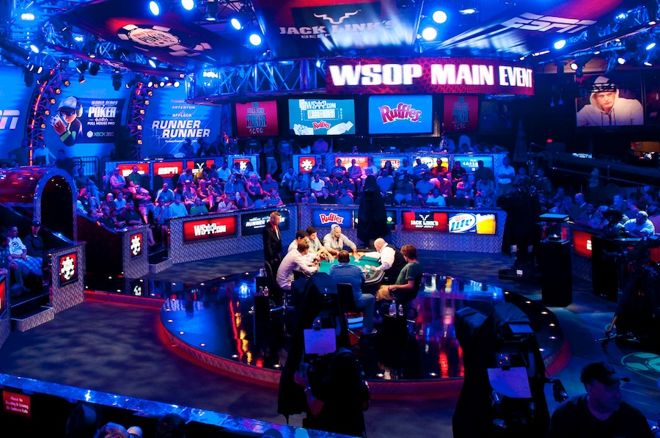
Covering live poker tournaments for a living affords me the chance to look countless thousands of hands played out, a lot of which give interesting and potentially valuable insights into how players — both amateurs and professionals — play the sport. On this ongoing series, I'll highlight hands I've seen on the tournaments I've covered and notice if we will glean anything useful from them.
The Scene
Last week, we looked over a hand from the 2016 World Series of Poker Main Event that aired on Episode 5 of the coverage. This week, there has been yet another hand from that very same episode I WISHED to discuss.
The hand occurred on Day 5 when there have been just over 100 players left from the starting field of 6,737. There has been unknown action preceding the cameras showing up, however the pot was at 285,000 with blinds of 25,000/50,000/5,000. Both players on this hand were playing north of 6 million, so that they were very deep, with Andrei Konopelko acting first and Michael Niwinski having position
The Action
The board read 


 on fourth street, and with
 Konopelko bet 80,000. Niwinski, holding
 , called the bet, bringing the pot to 445,000.
The river was the  , putting five spades at the board. Konopelko bet again, this time 135,000. Niwinski raised to 455,000, and Konopelko folded, ceding the pot of just a little over 1 million to Niwinski.
Concept and Analysis
This hand is a brilliant example of ways tournaments sometimes require adjustments at the fly. It also shows the way it is very important to have the versatility to switch a plan even within a single hand.
 Andrei Konopelko
For starters, Niwinski calls a small bet at the turn with an excessively marginal hand. He has to figure top pair may well be best, and if not, there's various room to move with position and probably turn his hand right into a bluff at the river irrespective of what falls.
Remember, Konopelko bet 80,000 right into a pot of 285,000, and the players have various chips back as each started the hand with well over 100 big blinds. Thus, Niwinski can call without fear that he is going to be facing a massive, stack-altering bet at the river. This, by the way, is the "hammer" concept outlined by David Sklansky and Ed Miller of their book No-Limit Hold'em Theory and Practice.
When the river brings the for a last board of , giving both players an obvious flush, things get really interesting. Konopelko decides to bet 135,000 into 445,000 — an excessively small bet.
I don't really like this sizing for essentially the most part. It's hard to look Konopelko betting like that with a large spade — wouldn't he wish to get some value from his hand, a minimum of around half-pot? If he has a mediocre spade, he's giving Niwinski extra space to bluff him off of his hand with a large raise without committing an excessive amount of of his stack. And if he has air, the similar concept applies to a rebluff opportunity. Plus, some players might just shrug and get in touch with to check out and chop.
As for Niwinski, he springs into action, sensing he has a possibility to show his top pair right into a bluff, and makes a pleasing raise to 455,000. If Konopelko actually has the  , he will let Niwinski know with a reraise and Niwinski can dump the hand, still comfortably sitting on a big stack. If Konopelko has some other spade, it is a very tough call as Niwinski could presumably have a number of big spades in his range for the reason that he's within the hand with a few Broadway cards because it is.
This bluff could be so much dicier if stacks were shallower, as Niwinski would have had less fold equity and would was committing more of his stack, damaging his tournament equity if the bluff failed. But Niwinski correctly realized there has been such a lot money behind that he could represent a number of hands according to his opponent's river play. Maybe he had the most efficient hand, and perhaps Konopelko would provide up an opportunity to show his hand right into a bluff in response to bet sizing and reads.
Niwinski showed how being flexible when in position with deep stacks can result in profitable scenarios. They are saying you need to have a plan, and it often is. But be capable to adjust that plan when circumstances allow.
Be certain to complete your PokerNews experience by testing an outline of our mobile and tablet apps here. Stay on top of the poker world out of your phone with our mobile iOS and Android app, or fan the flames of our iPad app for your tablet. You can even update your personal chip counts from poker tournaments all over the world with MyStack on both Android and iOS.
PokerNews.com is the world's leading poker website. Among other things, visitors will discover a daily dose of articles with the newest poker news, live reporting from tournaments, exclusive videos, podcasts and such a lot more.
PokerStars is the most important online poker room offering the largest amount of poker games and different game variations including Texas Hold'em, Omaha and other popular poker games. By joining PokerStars you'll easily learn the entire poker rules and poker strategy by playing free poker games. Join PokerStars and luxuriate in high quality online poker.

Read More... [Source: PokerNews]

No comments:
Post a Comment